

Brief Introduction
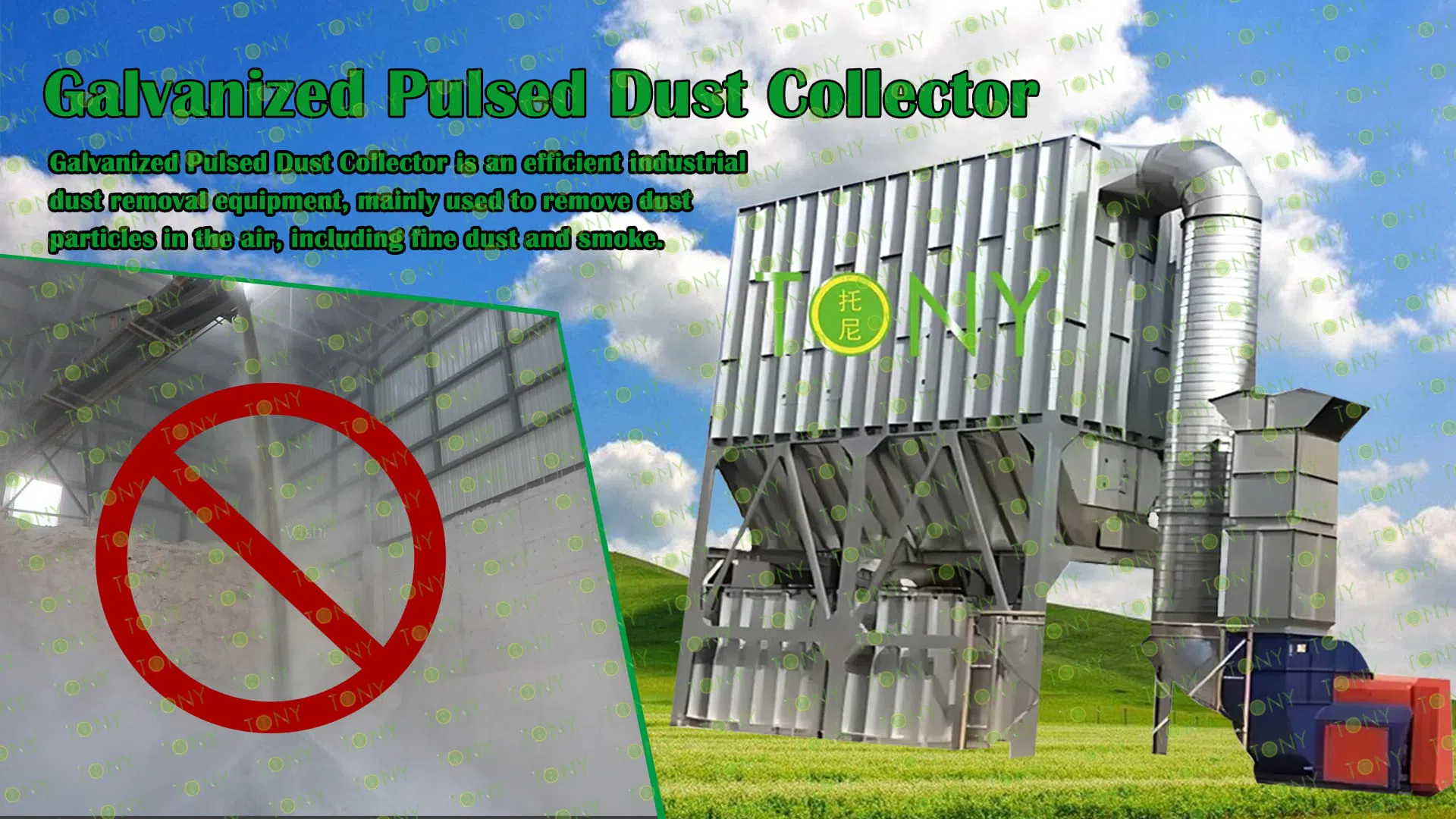
The pulsed dust collector is the most widely used type of dry filtration dust removal equipment in industry. It operates on the principle of filtration via filter bags combined with compressed-air pulse-jet cleaning, enabling continuous dust capture and compliant emissions; it is extensively used for dust control across various types of factories.
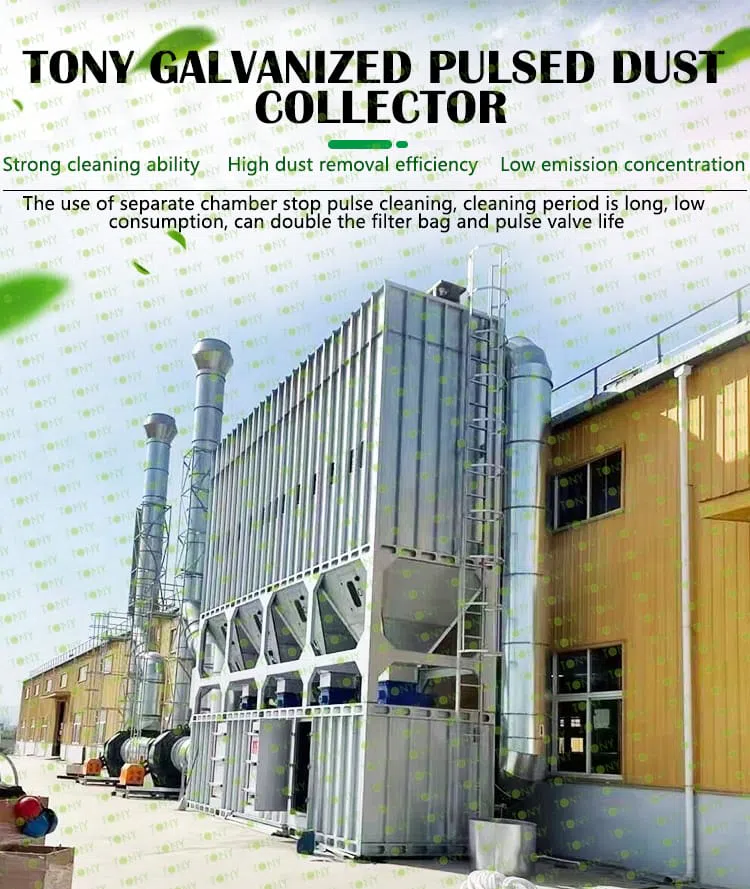
TONY galvanized pulsed dust collector is a unit featuring a housing made of hot-dip galvanized steel—distinguishing it from standard models with painted or powder-coated carbon steel casings. While it shares the same core dust-removal mechanism as conventional pulse-jet fabric filter collectors, its primary advantage lies in the housing's rust and corrosion resistance, making it ideal for workshop environments characterized by high humidity, moisture, or mild corrosiveness.
Working Principle
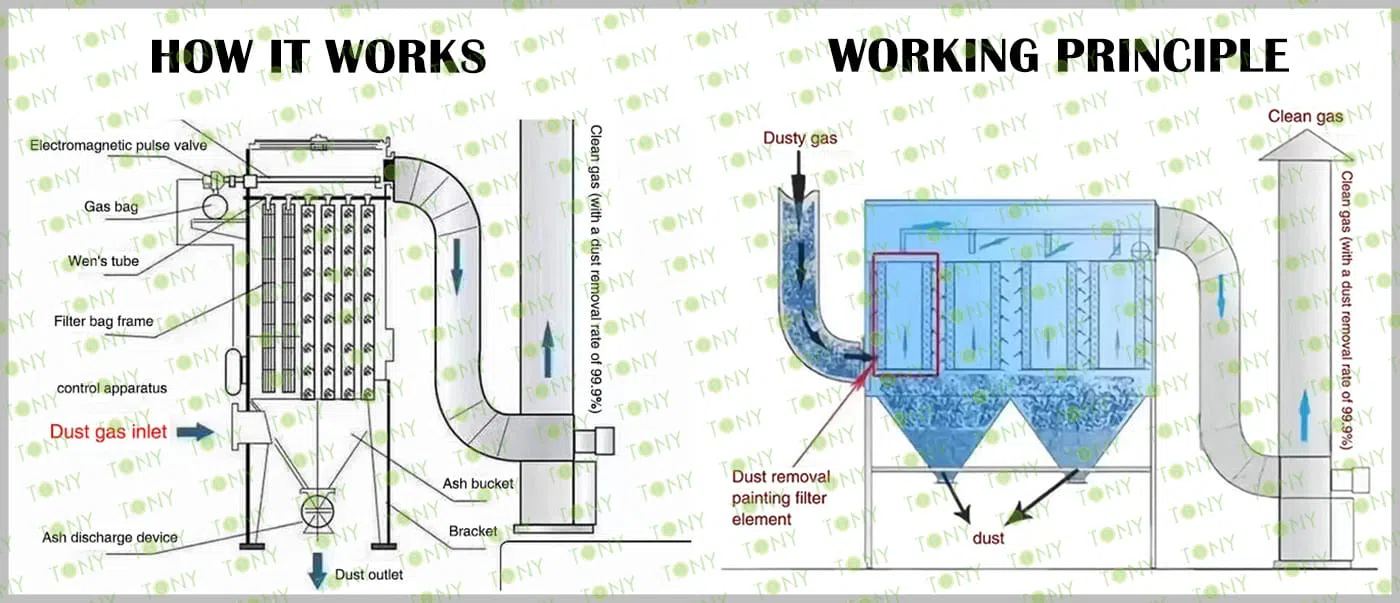
The entire unit operates under negative pressure (the fan is positioned at the air outlet to prevent dust from entering the fan).
1.Filtration: Dust-laden gas enters the dust collector's hopper, where large dust particles settle due to gravity. Fine dust rises with the airflow and is trapped on the outer surface of the filter bags. Clean air passes through the filter bags into the clean air chamber and is exhausted into the atmosphere via the induced draft fan.
2.Pulse Cleaning: As dust accumulates on the filter bags, the equipment's resistance increases. A pulse controller sends a signal based on preset time intervals or pressure differentials to open the electromagnetic pulse valve. Compressed air from the air reservoir is instantly injected into the filter bags, causing them to rapidly expand and shake; the dust on the surface dislodges and falls into the hopper.
Cleaning methods include online cleaning (the dust collector continues to operate during cleaning) and offline cleaning (the unit is divided into compartments; the inlet to the compartment being cleaned is closed, resulting in superior cleaning performance suitable for high dust concentrations).
3.Dust Discharge: Dust collected in the hopper is periodically discharged via a rotary discharge valve and a manual slide gate valve.
Main Parts
The main structure of the Galvanized Pulsed Dust Collector is divided into four parts: 1.Purification Part: composed of filter bag, filter bag bracket, filter bag frame, dust gas inlet, purification gas outlet, etc. 2.Spray Part: composed of pulse controller, pulse valve, spray pipe, air bag, etc. 3.Ash Discharge Part: composed of motor, reducer, screw transport aircraft, star ash discharge valve, etc. 4.Shell part: composed of upper shell, middle shell and lower shell. The figure on the right shows the main parts as follows: ①Exhaust gas inlet ②Check the door ③Observation port ④Inspection port ⑤Repair elevators and guardrails ⑥Induced draft fan ⑦Grey box | 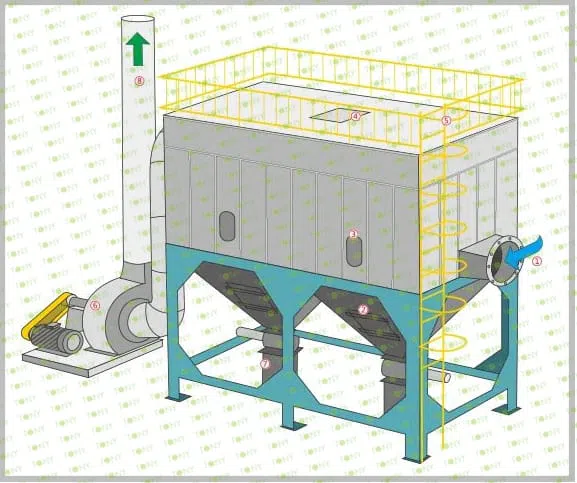 |
Parameter
Equipment Parameter | |||||||||
Model | Treated air volume | External dimension | Material thickness | Wind speed | Filter area | Bag specification | Solenoid valves | Skeleton | Rupture disks |
TY-MCBD-5K | 5000 | L1500*W1400*H4500 | Galvanized plate | 2-3 | 29 | ∅140L 1500 | 6 | Spring-loaded | 2 |
TY-MCBD-10K | 10000 | L1800*W1700*H4800 | Galvanized plate | 2-3 | 56 | ∅140L2000 | 8 | Spring-loaded | 2 |
TY-MCBD-12K | 12000 | L1800*W2200*H4800 | Galvanized plate | 2-3 | 69 | ∅140 L2000 | 10 | Spring-loaded | 4 |
TY-MCBD-15K | 15000 | L2200*W2200*H4800 | Galvanized plate | 2-3 | 89 | ∅140 L2000 | 10 | Spring-loaded | 4 |
TY-MCBD-20K | 20000 | L2500*W2200*H4800 | Galvanized plate | 2-3 | 105 | ∅140 L2000 | 12 | Spring-loaded | 4 |
TY-MCBD-25K | 25000 | L2500*W2200*H 6800 | Galvanized plate | 2-3 | 156 | ∅140 L3000 | 12 | Spring-loaded | 4 |
TY-MCBD-30K | 30000 | L3000*W2200*H6800 | Galvanized plate | 2-3 | 189 | ∅140 L3000 | 14 | Spring-loaded | 6 |
TY-MCBD-40K | 40000 | L3300*W2200*H6800 | Galvanized plate | 2-3 | 226 | ∅140 L3000 | 16 | Spring-loaded | 6 |
TY-MCBD-50K | 50000 | L4200*W2200*H6800 | Galvanized plate | 2-3 | 283 | ∅140 L3000 | 20 | Spring-loaded | 8 |
TY-MCBD-60K | 60000 | L5200*W2500*H6800 | Galvanized plate | 2-3 | 334 | ∅140 L3000 | 20 | Spring-loaded | 8 |
What Are The Application Areas?
Pulsed Dust Collectors are dry-type dust removal systems that filter dust-laden gas using filter bags. Suitable for the vast majority of dry, non-sticky dusts, they are the most widely used equipment for industrial exhaust dust control.
1.Building Materials Industry:
Cement production lines (raw material crushing, clinker handling, packaging), sand and gravel aggregates, stone crushing, stone processing, ceramics, glass, refractories, and gypsum board production.
2.Metallurgical Industry:
Iron and steel plants (sintering, blast furnaces, steelmaking), non-ferrous metal smelting, foundries, grinding and sandblasting operations, and metal mining and beneficiation.
3.Biomass / Grain & Feed (Areas of interest to you):
Biomass pellet production lines (crushers, pellet mills, cooling and screening units, silos), grain drying, feed processing, and dust control for wood chips, wood flour, and straw crushing.
4.Chemical Industry:
Production of plastics, rubber, carbon black, fertilizers, pharmaceuticals, coatings, and pigments.
5.Mining Industry:
Coal mines, limestone quarries, and metal mines; dust control for crushing, screening, and conveyor transfer points.
6.Mechanical Processing:
Grinding and polishing, sandblasting workshops, welding fumes (using specialized filter media), and metal cutting dust.
7.Power Industry:
Coal-fired power plant boiler dust removal, fly ash collection, and boiler room flue gas purification.
8.Solid Waste & Garbage:
Waste incineration, kitchen waste treatment, and dust control for the crushing and sorting of recycled materials.
9.Light Industry:
Woodworking and furniture sanding, papermaking dust, and tobacco processing.

Features
 | 1.Efficient Dust Cleaning: Uses pulse-jet cleaning for thorough dust removal and stable airflow resistance, maintaining consistently high dust collection efficiency. 2.High Airflow Capacity & Modular Design: Available in single-unit or multi-chamber configurations to accommodate varying airflow requirements; compatible with dust-generating sources such as crushers, pelletizers, storage silos, and screening equipment. 3.High Dust Removal Efficiency: Utilizes bag filtration to achieve dust capture rates exceeding 99%, ensuring stable compliance with emission standards. 4.Automated Operation: Equipped with a pulse controller allowing for timed or differential-pressure-based cleaning, eliminating the need for continuous manual intervention. 5.Easy Maintenance: Features quick-access inspection doors for convenient filter bag replacement and a modular housing design for simple on-site assembly. 6.Excellent Sealing: Sealed housing joints minimize air leakage and reduce the risk of condensation. 7.Superior Corrosion Resistance: Hot-dip galvanized finish offers greater durability than standard painted carbon steel—resisting rust and peeling—making it ideal for workshop environments characterized by high humidity, moisture, or mild acidic/alkaline mists. |
Details
Model Selection Key Points
1.Determine the required airflow capacity (based on the size of the dust generation point and the volume of dust emitted); 2.Assess dust properties: temperature, humidity, concentration, flammability/explosiveness, and adhesiveness; 3.Select the filter bag material; 4.Determine the housing material: carbon steel, galvanized steel, or stainless steel; 5.Choose between online and offline cleaning modes; 6.Select auxiliary equipment: fan, dust discharge mechanism, and compressed air supply. Additional notes: Standard ambient-temperature dust: Galvanized pulse dust collector (corrosion-resistant, suitable for humid environments; the type mentioned earlier); High-temperature flue gas: Carbon steel housing + high-temperature resistant filter bags; Combustible dust (e.g., wood dust, aluminum powder): Explosion-proof pulse dust collector (equipped with explosion relief vents and anti-static filter bags). |  |
Key Precautions for Daily Operation
 | The core mechanism of the galvanized pulsed dust collector involves filtration via filter bags combined with compressed air pulse-jet cleaning, enabling continuous dust capture and compliant emissions. If the galvanized coating is compromised by impact or welding, the damaged areas become susceptible to rust and lose resistance to strong acids and alkalis; additionally, filter bags and pulse valves are wear parts that require regular maintenance and replacement. Particular attention should be paid to the following points during daily operation: 1.Compressed air must be dry and free of moisture; moisture-laden air can cause filter bags to become clogged or "blinded" and accelerates internal corrosion of the housing. 2.If there is a risk of condensation within the housing, thermal insulation must be applied; measures should also be taken to prevent dust from caking or bridging in the hopper. 3.Areas where the galvanized coating has been damaged by welding or cutting should be touched up on-site with zinc-rich paint to prevent rusting at the damaged spots. 4.Regularly monitor the equipment's differential pressure; a sudden rise indicates filter bag clogging, while a drop indicates filter bag damage or leakage. |
Customer Case
Team

Exhibition
Contact Us
If You Are Interested,Please Send Us Inquiry Freely.
Before quotation we need to know:
1. Where is your specific use occasion?
2. What is the particle size of the dust you want to deal with?
3. What is the temperature of the dust you want to deal with?
4. What kind of control do you want? Constant pressure control or timing control or manual control?


