

Brief Introduction
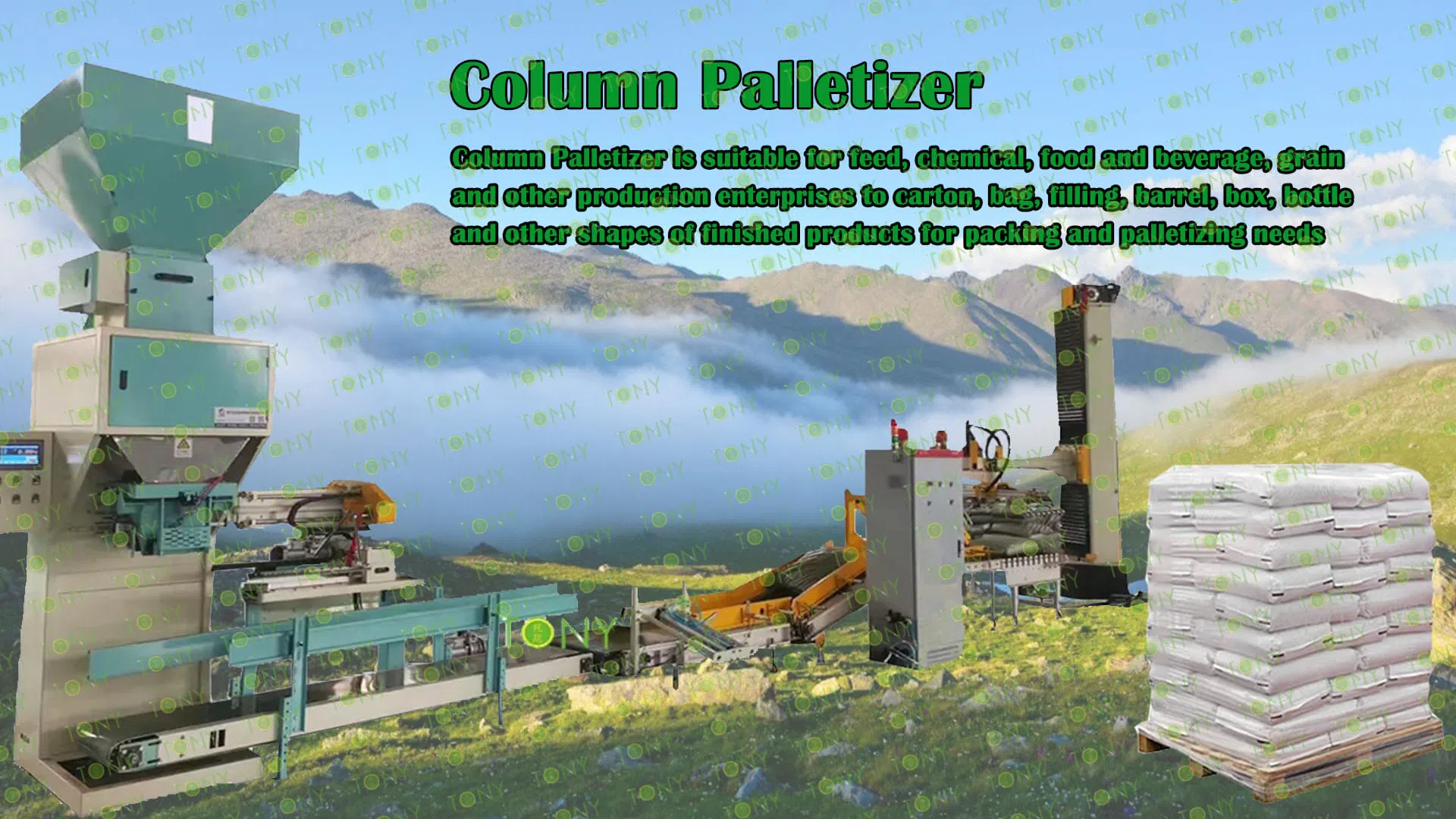
TONY column palletizer is an automatic stacking machine for production line end. It adopts 4-axis servo drive with single column structure. The arm rotates, lifts and stretches to grab bags or cartons and stack them neatly on pallets.
TONY column palletizer features small footprint, stable operation and low cost. It can work continuously for 24h and replace manual stacking.
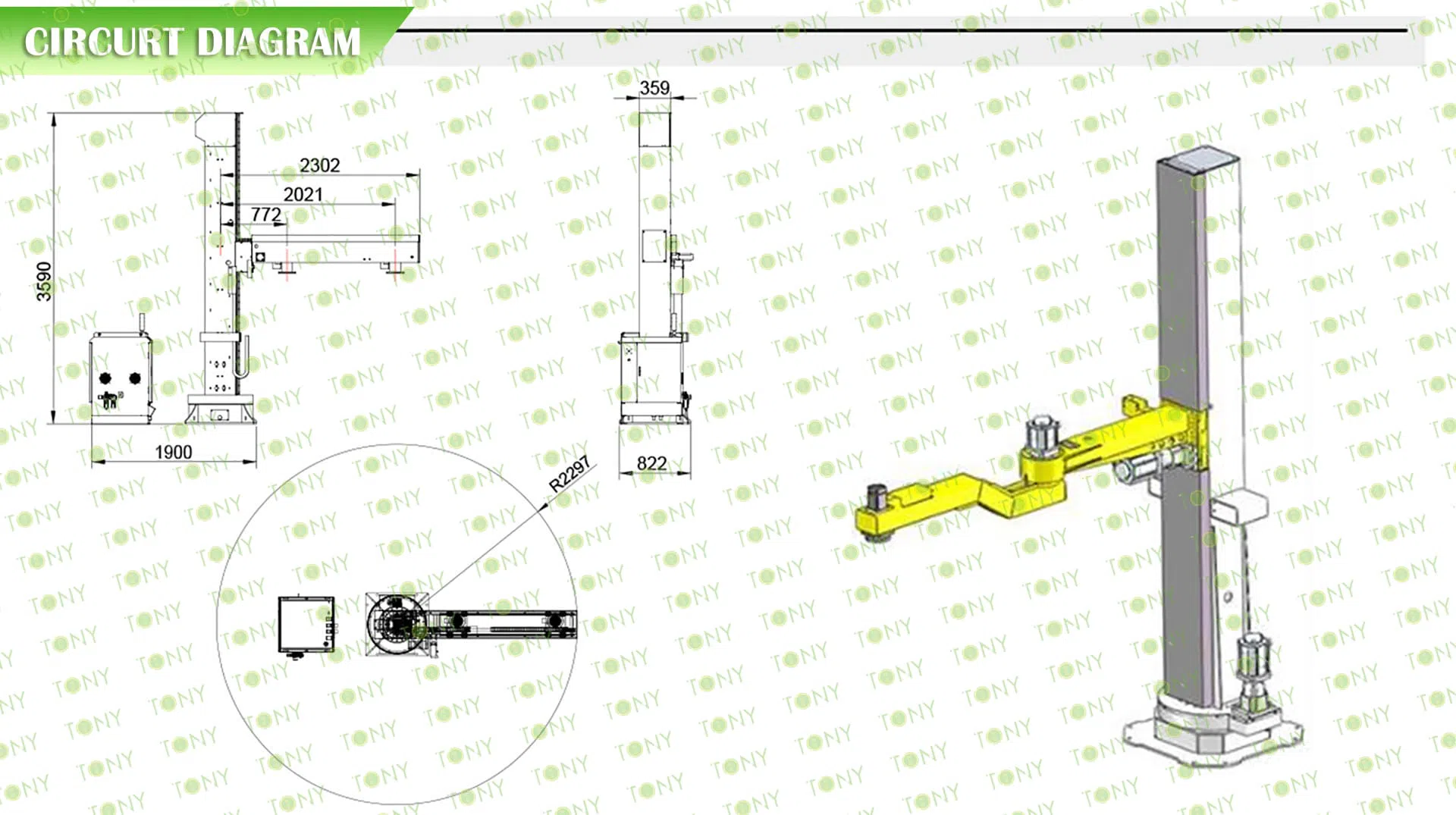
TONY column palletizer is widely used for biomass pellets, feed, organic fertilizer, grain bags, cartons and film packs. Speed: 400–600 bags per hour, max stacking height up to 2600mm.
Custom grippers for woven bags, vacuum cups for cartons. Optional auto pallet feeding system. It can connect with automatic packaging machines.
The column-type palletizer—also known as a single-column palletizer—is an automated palletizing unit used at the end of a production line; it is classified as a four-axis servo-driven mechanical palletizing system.
Working Principle
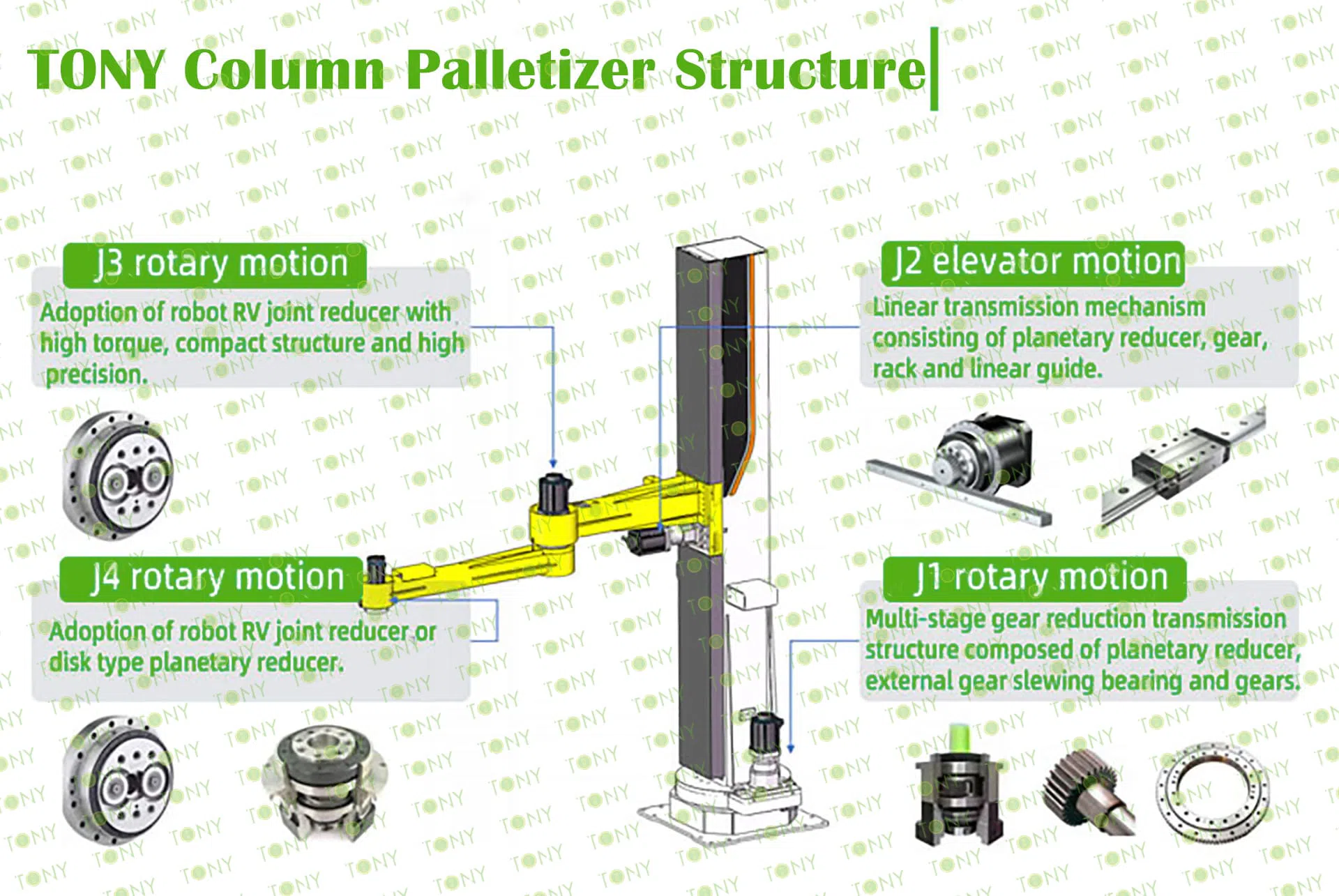
The column palletizer utilizes a four-axis servo control system to automate stacking operations. Designed specifically for the end-of-line stage of bagging production lines, it is primarily used for the automatic palletizing of packaged goods such as biomass pellets, animal feed, organic fertilizer, and grain. Featuring a vertical column as its main structural support, the machine employs coordinated four-axis movement—rotation, lifting, extension/retraction, and gripper rotation—to precisely execute the entire process of picking, transferring, and layer-by-layer stacking.
During operation, finished bags are smoothly conveyed to the pickup station, where they are aligned and positioned. The robotic arm extends precisely, and a specialized gripper securely holds the bag; the column then rotates in coordination with the cantilever’s lifting and extending actions to smoothly transfer the material over the pallet. The system automatically adjusts the placement angle and position based on a preset stacking pattern, ensuring an orderly, interlocking stack that is stable and resistant to collapse.
After each layer is completed, the machine automatically adjusts its vertical position and continues the stacking cycle layer by layer until the target height is reached. Once the full stack is finished, the machine resets for the next operation, and the loaded pallet is conveyed out for transport to storage via forklift. The entire process is managed by an intelligent PLC control system, enabling fully automated operation without the need for frequent manual intervention—requiring only periodic pallet replenishment. This system supports continuous, stable 24-hour production, effectively replacing manual labor and significantly enhancing both the production line's automation level and stacking efficiency.
Palletizing Type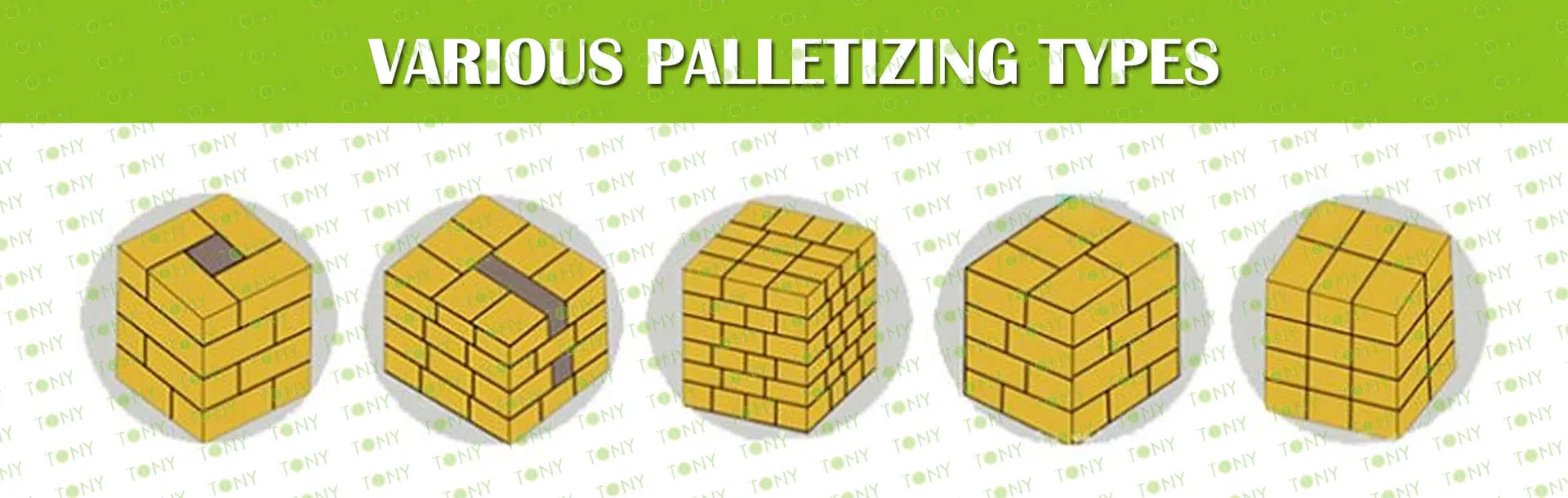
Main Parts
1.Column and Frame: A welded main structure made of heavy-duty steel sections serves as the core support; it houses internal lifting guide rails and drive mechanisms, offering high load-bearing capacity and dust resistance. 2.Four-Axis Servo Drive System: Includes axes for base rotation, cantilever lifting, cantilever extension, and gripper rotation; servo motors ensure precise motion control and stable positioning. 3.Gripper/End-Effector: Features quick-change capability. Options include clamp-style grippers for woven bags, vacuum suction cups for cartons, and hugging grippers for drums; a specialized woven bag gripper comes standard with biomass pellet production lines. 4.PLC Touchscreen Control System: Includes multiple preset palletizing patterns that can be selected or customized; features production statistics, fault alarms, and emergency stop protection. | 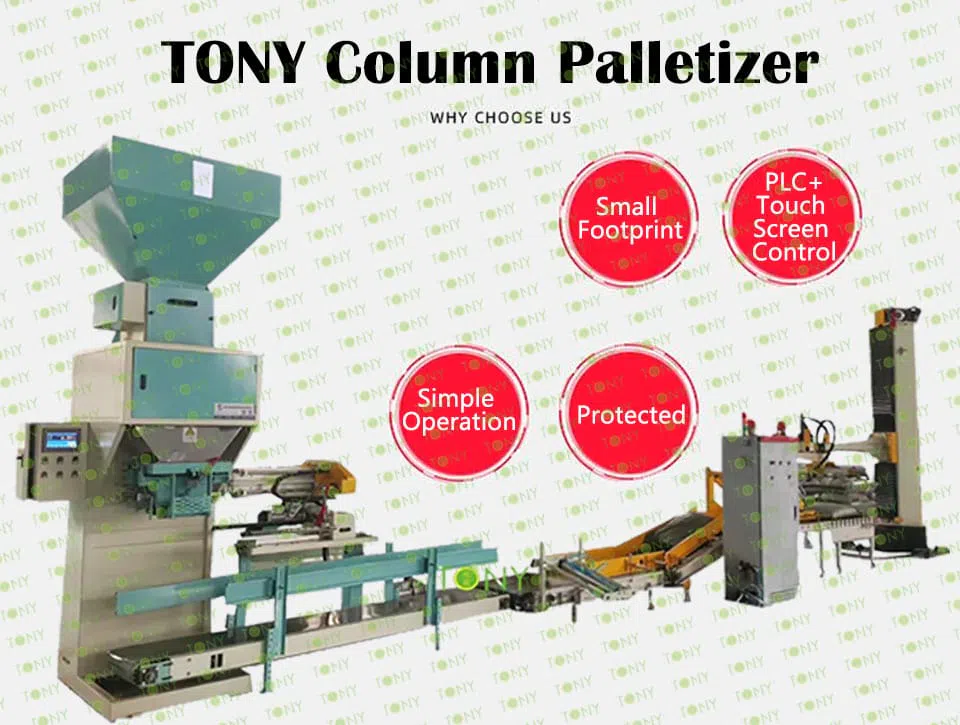 |
5.Pallet Conveying Mechanism (Optional): Automates pallet supply and full-pallet discharge for continuous, unmanned production; a simplified version requiring manual pallet placement is also available.
6.Safety Protection System: Includes safety fencing, photoelectric sensors, and emergency stop buttons; the equipment automatically halts operation if personnel inadvertently enter the work zone.
Parameter
1 | Palletizing capacity | 350-400 times/hour |
2 | Palletizing layers | 5-10 layers |
3 | Maximum stacking height | 1.9 meters |
4 | Program storage Unlimited | Unlimited |
5 | Palletizing working time | 24 hours continuous operation |
6 | Palletizing environment | Meet the buyer's production environment |
Features
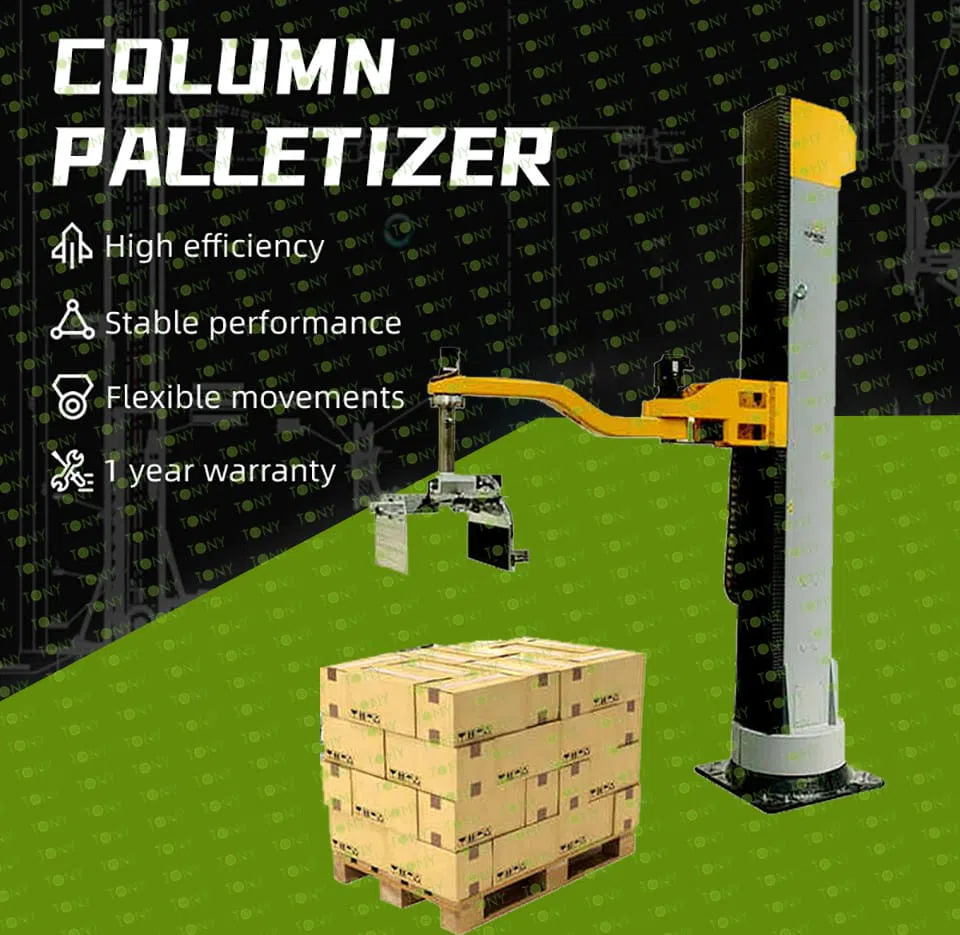 | 1.Small footprint. Its compact, single-column structure requires minimal installation space, making it ideal for retrofitting older factories or for production lines with spatial constraints. 2.High cost-performance ratio and easy maintenance. Procurement costs are significantly lower than those of six-axis articulated robots; it uses standard parts, is easy to maintain, and incurs low long-term upkeep costs. 3.Suitable for dusty environments. The unit features a dust-resistant design—including protection for guide rails and servo motors—making it suitable for long-term operation in workshops with high dust levels, such as those handling biomass pellets or organic fertilizers. 4.Supports dual-station operation. With a wide 290° rotation range, a single unit can alternately palletize loads onto two pallets or interface with two packaging lines, thereby maximizing equipment utilization. 5.Neat and stable palletizing patterns. The PLC stores multiple pre-set patterns; bags are stacked in an interlocking arrangement to create a compact, stable load that resists collapse, facilitating container shipping and forklift transport. |
6.Replaces manual labor for continuous production. Capable of 24-hour uninterrupted operation, it reduces the need for manual palletizing staff, thereby lowering labor costs and minimizing on-site safety risks.
7.Designed for bagged materials. Equipped with a specialized gripper for woven bags, it ensures stable handling without damaging the bags; it can interface directly with packaging machines to form a complete automated production line.
8.Comprehensive safety features. Comes standard with safety fencing, photoelectric protection, and an emergency stop mechanism; the system automatically halts operation if personnel inadvertently enter the work zone, ensuring production safety.
Public Works Conditions
1.Power Supply (Single Production Line) Power supply voltage: AC380V±10% 50HZ Control power supply: DC24V Power consumption: ~8KW 2.Air Supply (Single Production Line) Standard instrument air Pressure: 0.4~0.6MPa Air consumption: 3~5 Nm3/H 3.Environment Temperature: -10~+50℃ Humidity: ≤90% (no condensation) 4.Floor Thickness: ≥18CM standard concrete | 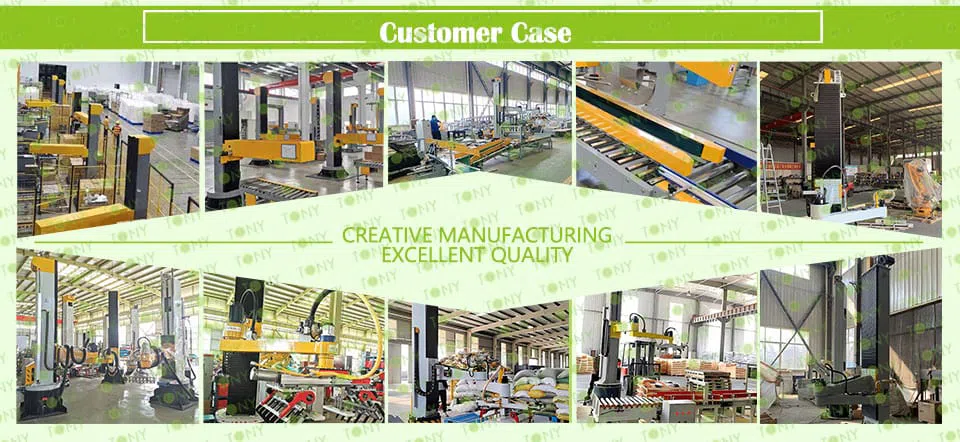 |
Model Selection Key Points
1.Packaging Type: Select a clamp gripper for woven bags or a vacuum suction cup for cartons; verify the weight of individual bags;
2.Capacity Matching: Palletizing speed must align with the output of the upstream packaging machine;
3.Pallet Load Specifications: Confirm pallet dimensions, number of layers, and maximum stacking height;
4.Workshop Site: Measure the length, width, and height of the installation area and allocate space for safety fencing;
5.Pallet Handling: Manual pallet placement for basic models; automatic pallet dispensing for fully automated lines;
6.Environment: For workshops with biomass pellet dust, prioritize the use of dust-proof guide rails and dust-proof servo motors.
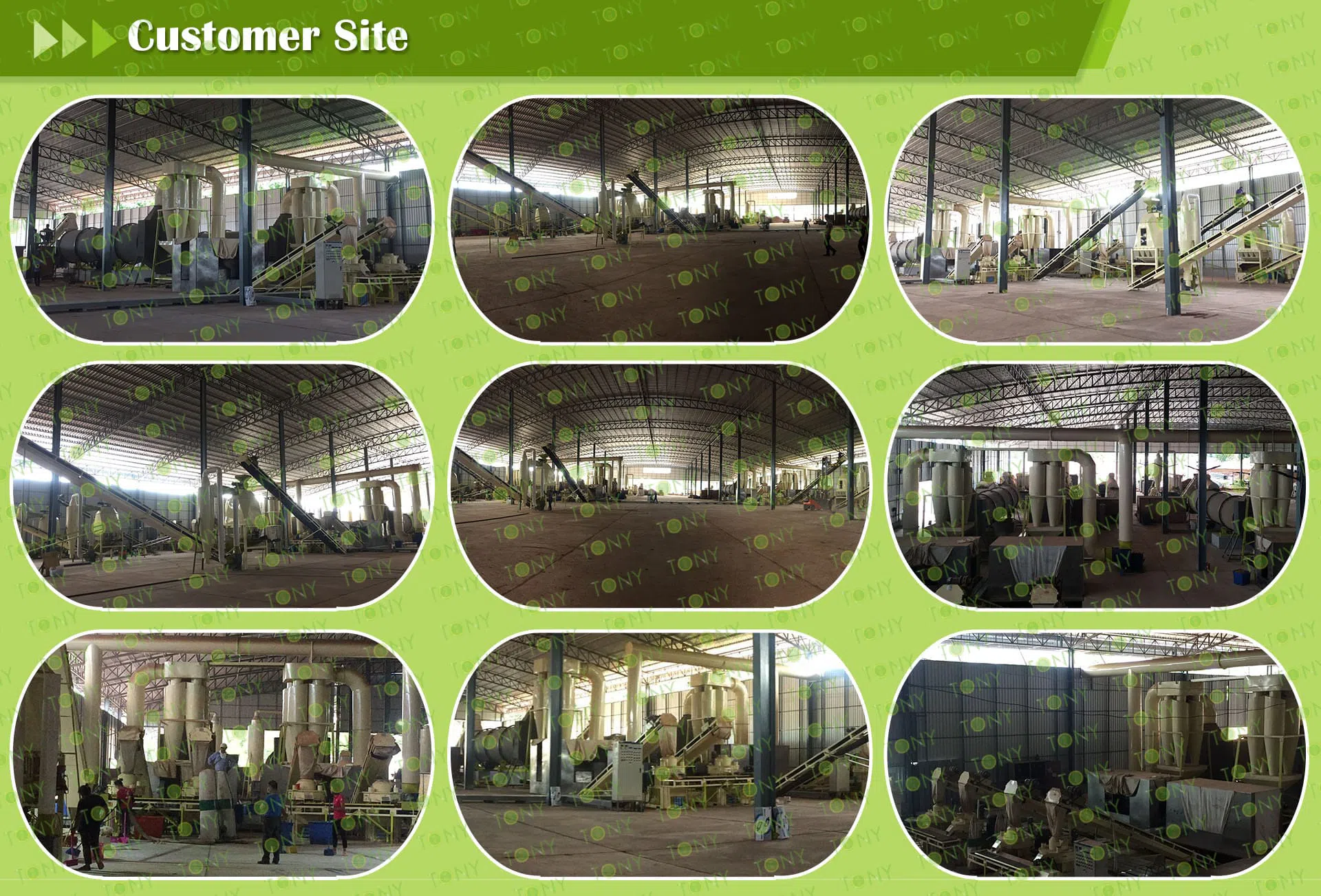
Customer Case
Cuatomer Visiting
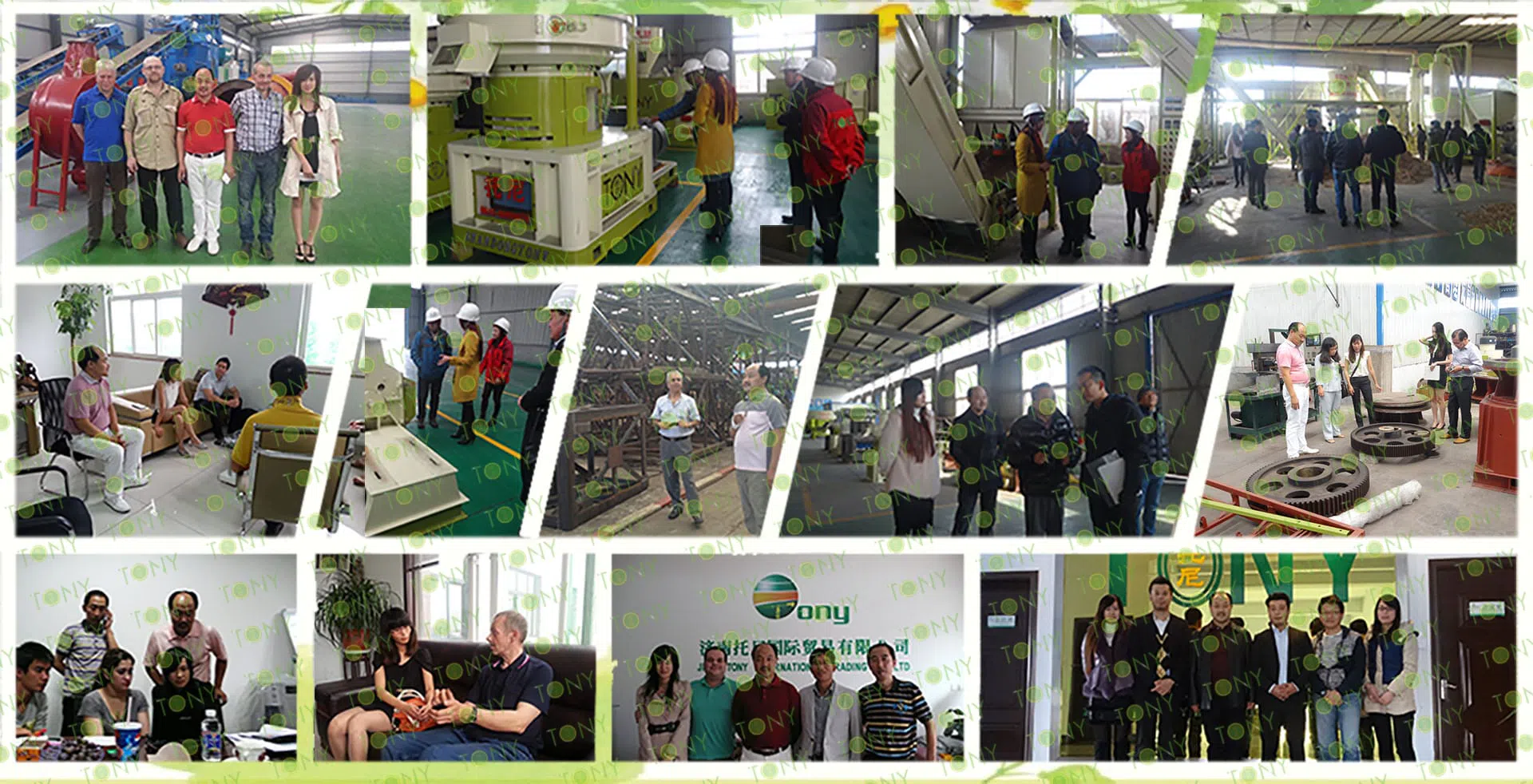
TONY Exhibition

TONY Service
24 Hours Online Service. -Inquiry will be replied within 2 hours. -All-the-way tracking service offered from placing order to delivery. -Free training for operation, debugging and daily maintenance. -We can provide professional guide installation. -One year warranty and all-round after-sales service. -Customized design and flow chart are available for our clients. -Independent R&D team and strict & scientific management system | 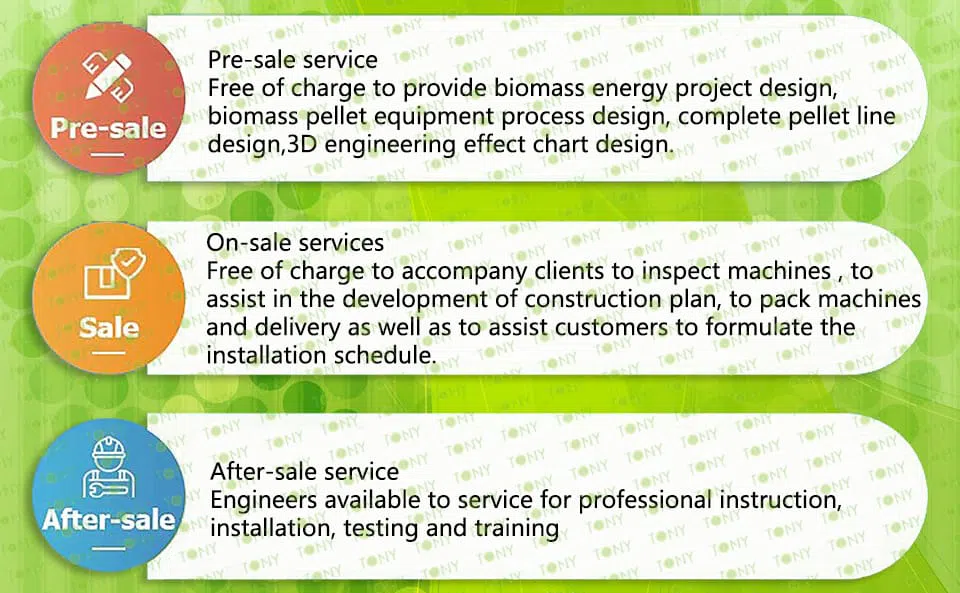 |


